Our courses are designed for those ready to grow and achieve more. The programs are developed by practitioners with real-world experience and tailored to your goals.



First, Some Hard Numbers
Why 'People Don't Leave Companies, They Leave Bad Managers' Is Especially True in Kazakhstan


People join companies, but leave managers. This overused phrase became a cliché for a reason—both research and my personal experience as an employee confirm its truth. In Kazakhstan, where talent shortages coexist with high employee turnover, the problem of poor leadership becomes especially acute.
Average turnover rates in Kazakhstan vary depending on job level. According to a recent study by EY, blue-collar and support staff are the most affected by turnover—averaging 24.7% per year—while rank-and-file specialists see around 16.7%. In comparison, turnover among top management is significantly lower (7.5–8.7%). However, even a 15–20% annual turnover rate in managerial positions is already considered high in some sectors. In other words, Kazakhstani companies are losing employees faster than they can replace them: by the end of 2024, total turnover among frontline staff reached about 24%.
Average turnover rates in Kazakhstan vary depending on job level. According to a recent study by EY, blue-collar and support staff are the most affected by turnover—averaging 24.7% per year—while rank-and-file specialists see around 16.7%. In comparison, turnover among top management is significantly lower (7.5–8.7%). However, even a 15–20% annual turnover rate in managerial positions is already considered high in some sectors. In other words, Kazakhstani companies are losing employees faster than they can replace them: by the end of 2024, total turnover among frontline staff reached about 24%.
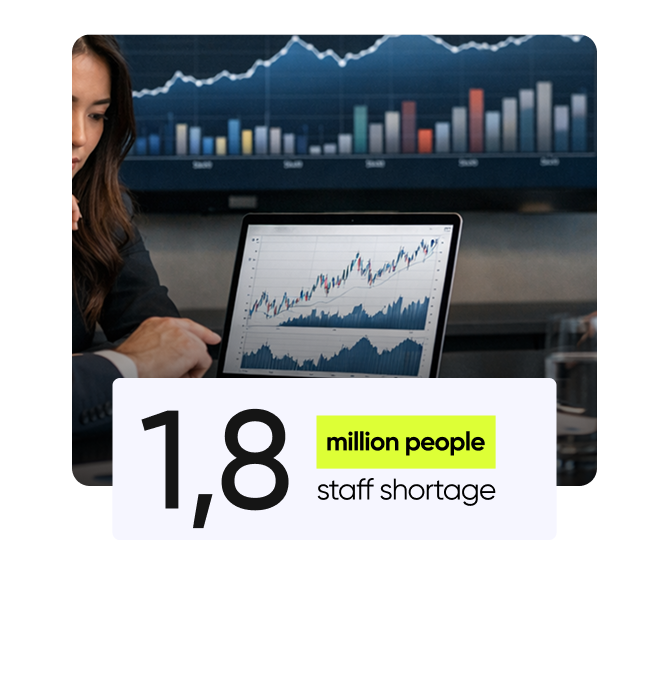
Together with the team, we studied several research reports and statistics and arrived at a very interesting picture. For several years now, Kazakhstani businesses have been facing a shortage of qualified specialists. According to the JSC “Labor Resources Development Center,” the workforce deficit in the country could reach 1.8 million people over the next five years. This so-called “talent shortage” is further exacerbated by high employee turnover. In 2021, amid the pandemic and social upheavals, some Kazakhstani companies experienced a surge in resignations—at certain production facilities, turnover increased by 50–80% within a year, and in sectors like HoReCa it reached 100% or more. Even in stable industries, the turnover rate rose from 5% (in 2020) to 8–9% in 2021.
How talent shortages, high turnover, and the generational gap impact business—and what to do about it. Explained by Ermukhamed Albisenov, CEO of ERA, who has been leading teams for 9+ years and shares practical tools and solutions in an article on e-r-a.kz.


In This Climate, Poor Leadership Becomes a 'Turnover Accelerator'
That’s why retaining key employees is more effective than endlessly hiring new ones.
But to retain them, it’s essential to understand the real reasons behind resignations. The conclusion I’ve reached over years of managing teams is that it’s not always about salary or economic factors—very often, people leave because of issues with management and the workplace environment.
But to retain them, it’s essential to understand the real reasons behind resignations. The conclusion I’ve reached over years of managing teams is that it’s not always about salary or economic factors—very often, people leave because of issues with management and the workplace environment.
When a valuable employee leaves a company, replacing them is neither easy nor cheap. It is a well-established fact that replacing one specialist costs a company roughly six months of their salary, taking into account recruitment, hiring, and onboarding expenses.
The losses from turnover are not limited to financial costs: productivity declines, projects slow down, and remaining colleagues may experience stress—or even leave following the departing employee.
The losses from turnover are not limited to financial costs: productivity declines, projects slow down, and remaining colleagues may experience stress—or even leave following the departing employee.
Why Employees Leave Bad Managers

In Kazakhstan, the reasons for employee turnover are also largely linked to factors controlled by management. According to a study by EY, the main drivers of turnover in our market include low salaries, dissatisfaction with working conditions, poor relationships within the team or with management, excessive workload, and a lack of career prospects.
Notice that, beyond financial factors, several of these causes point directly to management shortcomings: an uncomfortable work environment, lack of respect, disorganized processes, and no opportunities for growth. Another study showed similar findings: in addition to salary, unclear responsibilities and ineffective leadership are among the top three reasons. And while salaries can be increased relatively quickly, addressing incompetent management and fixing internal processes is much more difficult.
Notice that, beyond financial factors, several of these causes point directly to management shortcomings: an uncomfortable work environment, lack of respect, disorganized processes, and no opportunities for growth. Another study showed similar findings: in addition to salary, unclear responsibilities and ineffective leadership are among the top three reasons. And while salaries can be increased relatively quickly, addressing incompetent management and fixing internal processes is much more difficult.
A bad manager can turn an interesting job into a dead-end and unbearable experience, undermining all the company’s efforts to motivate employees. This leads to a situation where an employee first feels unhappy at work, then burns out and leaves—often without another job lined up, just to escape a toxic boss.
admitted that they left their jobs to escape a bad manager and improve their quality of life
According to Gallup, half of employees
50

If the company has a stressful environment or the management is difficult to deal with, they simply leave without spending years in a job they don’t love.
A New Generation with New Expectations: They Won't Tolerate It
After the events of early 2022, I noticed that people in Kazakhstan have become even bolder in this regard. Accumulated stress has made them less tolerant of an unfavorable psychological environment. Today, many are more actively seeking new opportunities and leaving employers they find unattractive more quickly. And this is not about the company’s brand, but about the conditions created by management and how they treat their team.
As for younger people, they value somewhat different things at work compared to Generation X or baby boomers. In my experience, for those aged 16–24, salary and stability come first, but right after that come the quality of the company’s product, equal opportunities, a positive team atmosphere, and a healthy work-life balance.
As for younger people, they value somewhat different things at work compared to Generation X or baby boomers. In my experience, for those aged 16–24, salary and stability come first, but right after that come the quality of the company’s product, equal opportunities, a positive team atmosphere, and a healthy work-life balance.
This is very similar to the phenomenon of the YOLO economy (You Only Live Once), where people consciously choose to change jobs in order to live and work in a more suitable environment.

I’m increasingly noticing that in Kazakhstan’s labor market, the younger generation—recent graduates, millennials, and Gen Z—is making itself heard more loudly. Their values differ significantly from those of older colleagues, once again confirming that people don’t leave companies as much as they leave managers.
Young professionals are not willing to tolerate outdated management styles or uncomfortable working conditions.
Young professionals are not willing to tolerate outdated management styles or uncomfortable working conditions.

It’s also important to highlight the issue of employee training and development. I believe that one of the key reasons people leave companies is the lack of growth opportunities. When an employee doesn’t see new horizons, doesn’t gain new knowledge or skills, they begin to feel stuck. The most ambitious simply move to places where they can grow.
If a company is not interested in developing its people, its most capable employees won’t stay. Conversely, in organizations where there is a culture of learning and real support for development, employees value it and respond with loyalty.
If a company is not interested in developing its people, its most capable employees won’t stay. Conversely, in organizations where there is a culture of learning and real support for development, employees value it and respond with loyalty.

No Growth Path: When Companies Don't Develop Their People
In Kazakhstan, unfortunately, there is still a huge gap between talk about the importance of development and reality. I see that people here genuinely want to learn: according to BCG, 71% of Kazakhstanis are willing to invest time and money in improving their skills. This is above the global average. More than 60% are even ready to retrain for a new profession if necessary. Yet, despite this strong desire for learning, not every employer is willing to support it.
The statistics are disappointing: in 2020, only 13% of employees in Kazakhstan received training or professional development funded by their company.
The reasons are understandable—crises and budget cuts. But for me, the very fact is concerning: most employers either do not offer development opportunities at all or do so only formally. Which means that those who want to grow will sooner or later look for another company.
For Kazakhstan, with its talent shortage, retaining employees is a strategic priority. The solution largely lies in the hands of managers.
If we act as leaders rather than “bosses,” respect people, and provide them with growth and flexibility, they won’t want to leave.
If we act as leaders rather than “bosses,” respect people, and provide them with growth and flexibility, they won’t want to leave.
Conclusion
People are the most important asset—but what truly matters is the relationships we build with them.
How to Retain Employees: Tools for Solving the Problem
I am convinced that a good specialist does not always become a good manager. That is exactly why at ERA we believe companies should deliberately develop management skills—from line managers to top executives. In my experience, only a small number of people truly possess natural leadership potential, but this can and should be taught. Emotional intelligence, the ability to give feedback, motivate, and mentor—none of this comes automatically. The difference between a “boss” who pressures people and a leader who develops the team is enormous. When a company invests in its managers, it gains loyal employees and a healthy team climate, which means lower turnover.
Leadership development for managers
Politeness, respect, and transparency are not just nice words in presentations, but the foundation of everyday work. I am convinced that toxic behavior has no place in a team: no shouting, no humiliation, no “emotional confrontations.” A manager should set an example of positive communication and the ability to solve problems constructively. Where there is trust, mistakes are addressed without fear, and everyone’s opinion is heard, people stay for the long term. And today, employees increasingly value a psychologically healthy environment and a reasonable workload more than one-time bonuses.
Building a healthy corporate culture
The pandemic changed the rules of the game: flexible schedules, remote work, or hybrid formats have become the norm. I see that young people in Kazakhstan now expect these conditions. For many, the ability to choose a work format is a key factor in employment. Flexibility also applies to management style: less micromanagement, more focus on results. This strengthens trust and team engagement.
Flexibility and focus on balance
Of course, the financial component matters. If salaries are significantly below market, it’s easier to raise them than to lose people and spend more on hiring later. But it’s not only money that keeps employees. There must be real growth prospects—horizontal moves, career progression, and a clear development plan. If an employee understands they can grow within 2–3 years, they will stay. If not, they will leave for a place where growth is possible.
Competitive compensation and growth
I have seen many times that investing in people always pays off. At ERA, we provide access to training programs, workshops, and courses, and support the desire to learn. When a person sees that a company invests in their development, they respond with loyalty. It’s important not only to offer formal training but also mentorship and knowledge sharing within the team. This reduces the likelihood that someone will look for growth opportunities elsewhere.
Employee training and development
The labor market in Kazakhstan is undergoing significant changes. Talent shortages, high turnover, and shifting employee expectations are forcing companies to rethink their approaches to people management. Today, it is not enough to simply offer a job and a salary—people expect respect, growth opportunities, a healthy work environment, and flexibility.
Conclusion
Regular surveys, open meetings, and honest dialogue—all of this strengthens trust. If a person can speak about a problem and be heard, they won’t accumulate negativity. We use tools to detect signals in time: for example, if an employee hasn’t received a promotion for three consecutive years, the risk of them leaving is higher. Such analytics help us act proactively.
Feedback and employee involvement

Phone
Astana, Dinmukhamed Street
Konaev, 14, 3rd floor
Konaev, 14, 3rd floor
Address
Email
Monday - Friday
10:00 AM - 7:00 PM
10:00 AM - 7:00 PM
Working hours
Navigation
Find a Course
Submit a request and we'll match you with a program based on your level, goals, and timeline.